Root canal treatment
Gentle, microscope-assisted treatment that removes the infected tissue from inside the tooth, disinfects the root canals and seals them so the tooth can be kept and restored.
About this treatmentEndodontist Market Harborough · Leicestershire
A painful, infected or previously treated tooth does not have to be lost. We provide endodontic care in Market Harborough — root canal treatment, retreatment and emergency relief — performed under an operating microscope with the single aim of keeping your own tooth.
Careful diagnosis first, a written plan you understand, and treatment paced around you.
Tell us your symptoms are acute when you get in touch — we keep time for emergency endodontic appointments.
Emergency root canal treatmentWhat an endodontist does
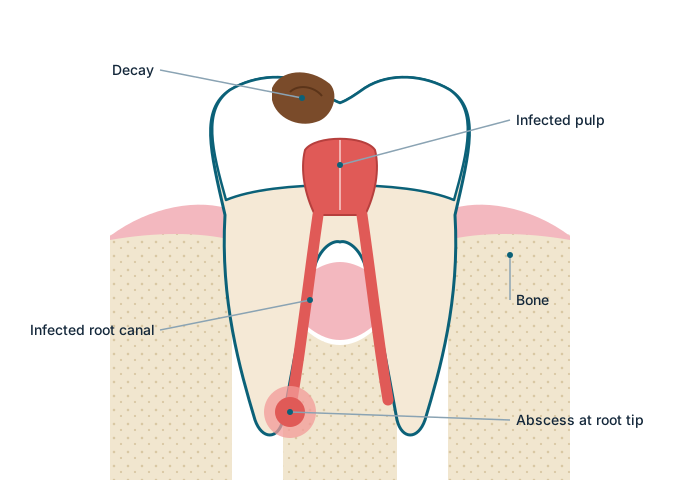
Endodontics is the branch of dentistry that deals with the dental pulp — the nerve and blood supply inside each tooth — and the infections that follow when it is damaged. Root canal treatment, retreatment of failed root fillings, root-end surgery and the care of cracked and injured teeth all fall within it.
Our practice in Market Harborough is dedicated to this work. We do not offer general dentistry; you remain a patient of your own dentist, who restores the tooth after we have treated it and continues your routine care. That focus is what allows us to invest in the microscope, the instruments and the appointment time that complex root canal treatment needs.
Whether you have been referred by your dentist or have found us yourself, the first step is the same: a thorough assessment and a plain explanation of what is wrong and what can be done about it.
Treatments
From a first root canal to the rescue of a tooth that has been treated before, every service begins with finding the real cause of the problem and ends with a tooth you can keep.
Gentle, microscope-assisted treatment that removes the infected tissue from inside the tooth, disinfects the root canals and seals them so the tooth can be kept and restored.
About this treatmentA second chance for a tooth whose earlier root canal treatment has failed: the old filling is removed, missed or infected canals are found and treated, and the tooth is sealed again.
About this treatmentEvery root canal is treated under an operating microscope, which reveals fine, curved and hidden canals that are easy to miss with the naked eye.
About this treatmentRoot-end surgery (apicectomy) performed under the microscope when infection persists around the root tip and treatment through the crown of the tooth is not possible.
About this treatmentCracks are examined under magnification to find out how deep they run, whether the pulp is involved and which option gives the tooth the best long-term chance.
About this treatmentAssessment and treatment of teeth that have been knocked, chipped, loosened or knocked out, including monitoring the nerve for months after the injury.
About this treatmentNot every toothache needs a root canal. Careful testing and the right X-rays pinpoint which tooth is responsible and what treatment, if any, it actually needs.
About this treatmentInfection at the root tip can cause pain on biting, a gum boil or swelling — or show only on an X-ray. We explain what has happened and how the tooth can be treated.
About this treatmentSee every service in one place, including emergency root canal treatment for acute pain and our honest assessment of whether a tooth can be saved.
All treatments and diagnosisWhat to expect
We listen to how the pain behaves, examine the tooth, carry out the diagnostic tests and take any X-rays needed. Bring recent X-rays from your dentist if you have them.
You leave the consultation knowing the diagnosis, the recommended treatment, the realistic prognosis of the tooth and the fee. Treatment is booked only once you are happy to proceed.
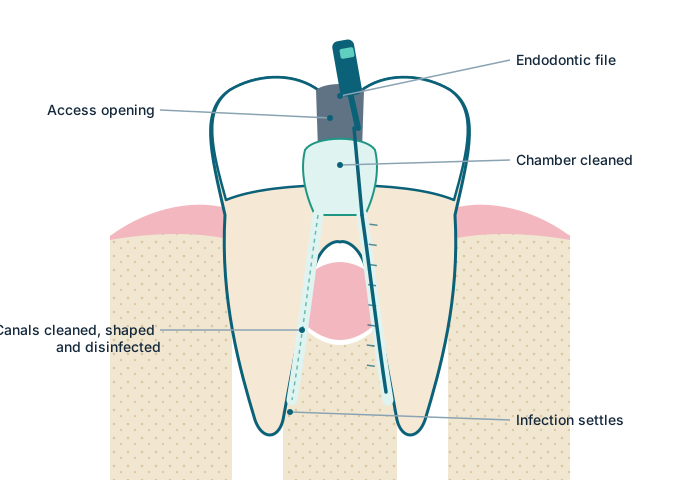
Under local anaesthetic and rubber dam, the root canal system is cleaned, disinfected and sealed under the microscope — usually in a single visit.
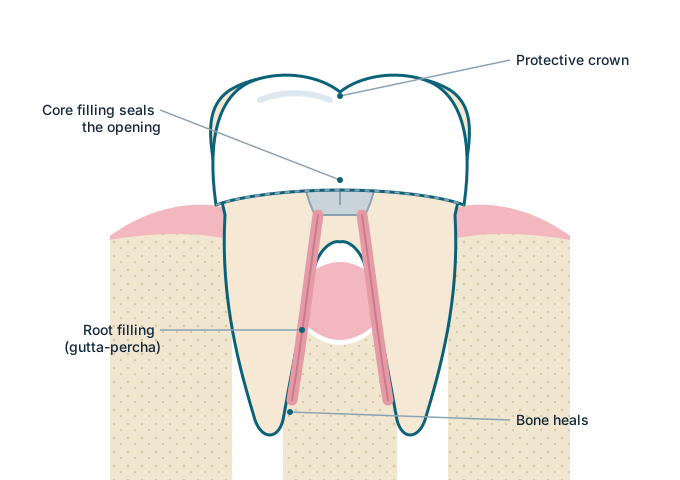
Your dentist places the final crown or filling. We review healing on an X-ray at a later date and send your dentist a full report.
Emergency root canal treatment
Throbbing pain that keeps you awake, pain that lingers after hot drinks, a tooth you cannot bite on or a swelling beside a tooth are signs that the pulp is inflamed or infected. Painkillers mask the problem for a while; they do not cure it, and an infection left alone can spread.
Call us and say that your symptoms are acute. Emergency appointments relieve the pain first — usually the same or next working day — and the full treatment is planned once you are comfortable.
Seek medical help immediately if a facial swelling is spreading quickly, you have difficulty swallowing or breathing, or you feel very unwell: contact NHS 111 or go to A&E.
About the practice
Endodontist Market Harborough exists to treat the problems that happen inside teeth, and to do that one job to a high standard. The clinical time, the equipment and the way appointments are scheduled all follow from that single focus.
Many of the patients we see are anxious — often because of an earlier difficult experience. We take that seriously: unhurried appointments, a clear explanation of what will happen before it happens, effective local anaesthetic that is tested before we begin, and the option to pause whenever you need to.
We treat adults and children, and you do not need a referral to see us, although we work closely with dentists across Market Harborough and the surrounding villages.
Precision tools
The root canal system is tiny and intricate. Canals divide, curve and calcify, and a molar frequently has a fourth canal that cannot be seen with the naked eye. Missing it is the most common reason a root canal treatment fails.
An operating microscope brings high magnification and a beam of light directly into the tooth. With it, canals are found rather than hunted for, old materials are removed without damaging the tooth, cracks can be judged accurately and the access cavity is kept as small as possible.
Alongside the microscope we use electronic root-length measurement, ultrasonic instruments, flexible nickel-titanium files, activated irrigation and low-dose digital X-rays — the same approach for every tooth, not just the difficult ones.
Technology serves judgement. Diagnosis and an honest view of the tooth's prognosis come first; the equipment lets us carry out the plan with precision.
Before you lose a tooth
An infection, a failed root filling or a "difficult" canal is not the same as a hopeless tooth. Under the microscope, many teeth that have been written off can be retreated or treated surgically and kept for years.
Equally, some teeth genuinely cannot be saved — a root that has split, or too little sound tooth left to hold a crown. In those cases we say so plainly, because treating a tooth with a poor outlook wastes your time and money and delays a better solution.
What you get from us is an honest, written assessment of the realistic options for your tooth, with the likely success of each.
Frequently asked questions
Short, straight answers. Our patient guides go into more depth.
No. The tooth is fully numbed with local anaesthetic before we start, and we test it. You will feel pressure and vibration, much as you would for a filling, but not sharp pain. Some tenderness on biting for a few days afterwards is normal and settles with ordinary painkillers.
Usually between 60 and 90 minutes. Most teeth are completed in a single visit; a heavily infected tooth, a retreatment or a tooth with unusual anatomy may need a second appointment.
No. You can contact us directly, and many patients do. If your dentist has already seen the tooth, let us know what they found and we will write to them after your visit so that your records are complete.
Root canals are narrow, curved and often hidden. Magnification and direct light allow every canal to be found, cleaned to its full length and sealed, which is what makes the treatment last. A missed canal is the most common cause of a failed root filling.
It is the treatment of a tooth that has had a root canal before and has become infected again. The old root filling is removed, any missed canals are found, the system is cleaned and disinfected and the tooth is sealed and restored once more.
Many general dentists carry out straightforward root canal treatment well. Teeth with curved or calcified canals, molars, failed previous treatments, cracks and injuries benefit from a practice that concentrates on endodontics and uses a microscope routinely. Our guide on endodontist or general dentist explains the difference.
Very often, yes. Removing the infected tissue from the canals and sealing them lets the bone around the root heal. The exceptions are teeth with a split root or too little sound structure to restore — and we will tell you honestly which applies to your tooth.
Back teeth almost always do, because a root-treated molar without cuspal coverage is prone to cracking. Front teeth can sometimes be restored with a filling. Your own dentist places the final restoration, and we recommend what is needed in our report to them.
Yes. Severe pain and swelling are seen promptly — tell us your symptoms are acute when you call. Emergency treatment relieves the pain first; the full treatment is completed at a planned appointment.
The fee depends on the tooth and the complexity of the treatment, so it is confirmed in writing after your consultation and before any treatment starts. There are no surprises partway through.
The infection persists in the bone around the root and may spread. Pain often comes and goes, which is misleading — a quiet period does not mean the problem has resolved. Over time the tooth becomes harder to save.
Patients come to us from Market Harborough and the surrounding villages, and from across south Leicestershire and north Northamptonshire. You do not need to live locally to be treated here.
Book a consultation
Call the practice to arrange a consultation or to ask about a tooth that is worrying you. You will speak to a person, not a form, and if you are in pain we will say so to the clinician straight away.
If you have severe pain or a swelling, please mention it when you call so that we can see you sooner.